 Ver todos los artículos

The shutter speed is one of the most crucial key elements that significantly affects the final outcome of any audiovisual project. Therefore, knowing what it is and how to change the shutter speed will be key to capturing the best photos and videos.
What is Shutter Speed?
The expression “shutter angle” itself is an anachronism that takes us back to the era of cinema pioneers. Cameras from the late 19th and early 20th centuries always featured a rotary shutter. This shutter was a flat disc that rotated at a constant speed in synchronization with the film frame transport mechanism. Operators at the time would interchange different discs in the camera depending on the angle. The simplest circle had half of its circumference open and, therefore, corresponded to a 180º angle, which has been interpreted as the standard for shooting any type of film. This standard became the benchmark for motion blur that audiences worldwide became accustomed to when they started watching cinematic images. To modify the exposure speed, the disc had to be physically changed. The smaller the angle, the greater the shutter speed, and vice versa.
Over time, the changing of discs became an internal camera mechanism. With the advent of electronic cameras, the shutter angle was replaced by shutter speed, which is actually the term we should be using today with any cinema camera.
In short, shutter speed is a term used in photography and cinematography that refers to the duration for which a camera’s shutter remains open to allow light to reach the image sensor or film. It is one of the key factors in image exposure, along with aperture and ISO sensitivity.
At AVisualPRO, we are a brand committed to the audiovisual sector. Therefore, we offer our clients a comprehensive camera rental service with which you can showcase your creativity to the world. Our cameras are ideal for working on all types of audiovisual projects, from professional shoots for commercials, films, and short films to music videos, webinars, online streaming, and much more. In our catalog, you can also find a wide variety of rental accessories and complements so you can have professional filming equipment at a very competitive price.
How to Calculate Shutter Speed?
Shutter speed is measured in seconds or fractions of a second. For example, a shutter speed of 1/250 means the shutter is open for one two-hundred-fiftieth of a second, while a speed of 1 second means the shutter is open for a full second.
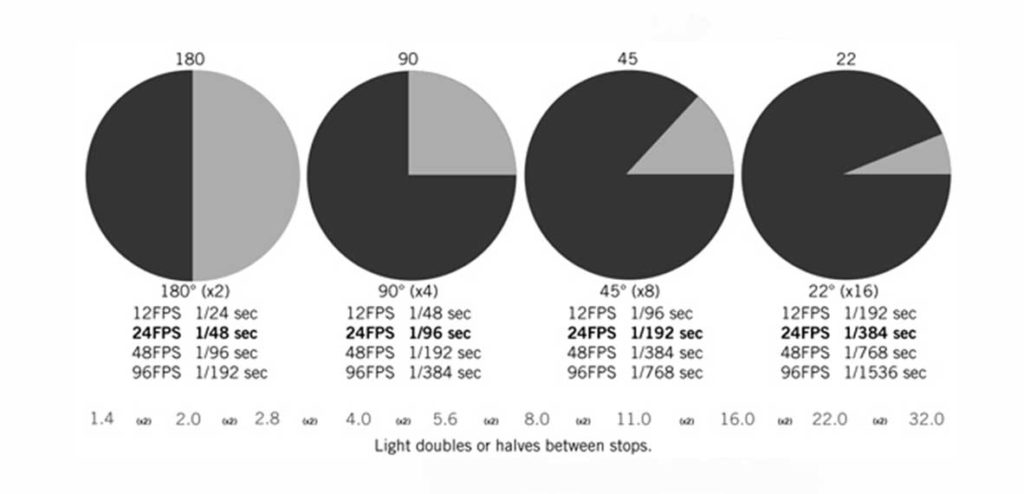
The formula for finding the shutter speed equivalent to any angle is simply to divide one second by the number of frames per second the project will have, multiplied by 360, and then divided by the desired angle.
At very high shutter speeds, images become increasingly shuttered and more contrasted, appearing to make small jumps between one frame and the next. This phenomenon is known as staccato and generates visual fatigue and tension in the viewer.
Shutter Speed for Video
Controlling the shutter speed for video, also known as “shutter speed,” refers to the time each video frame is exposed to light. Shutter speed in video affects the amount of motion blur visible in each frame. The general rule for determining the appropriate shutter speed in video is to use “double the frame rate.”
The most commonly used rule for setting shutter speed in video is the “180-degree rule,” which recommends that the shutter speed be double the frame rate to achieve natural motion blur that resembles how the human eye perceives movement. This comes from the concept of shutter angle in traditional film cameras, where a 180-degree shutter angle would expose the film for half the duration of a frame.
Examples of How to Change Shutter Speed
At faster shutter speeds, meaning shorter exposure times per frame, images can be obtained with less motion blur, making movement in the image appear more choppy or “crisp.” This can be useful in fast-action or sports scenes but may result in a less natural look. However, it is important to note that a stroboscopic effect can occur if the shutter speed is too high, especially at lower frame rates (like 24 fps), making movement appear choppy and unnatural.
At slower shutter speeds, with longer exposure times per frame, the image is perceived as more natural, which is generally sought after in most video productions. However, there is a risk of excessive blur in the video. If the shutter speed is too slow, there can be too much motion blur, which can make images appear blurry, especially in scenes with a lot of movement.
For example, in action photography to capture sports or wildlife, it is necessary to use a fast shutter speed, such as between 1/500 and 1/2000 of a second, to capture sharp images of fast-moving objects. This is ideal for capturing the movement of players in a football match or birds in flight, avoiding blur and highlighting details.
To create videos of night landscapes or in low light, a slow shutter speed of 1 second or more should be used to allow more light to reach the sensor. This is essential for capturing details in dark scenes, for capturing stars in the night sky or urban nightscapes, where light is limited and prolonged exposure is needed.
Controlling shutter speed is very necessary to achieve the motion blur effect, widely used to capture waterfalls or urban night lights. A very slow shutter speed, several seconds long, should be used to capture the continuous movement of lights or water, creating an artistic blur effect. This can be seen in photographs of night traffic, where car lights form streaks, or in waterfalls, where the water appears silky and fluid due to the prolonged exposure time.
If you need to work with professional, quality audiovisual equipment at the best price, don’t hesitate to check out our catalog, where you’ll find everything you’re looking for and much more!
Learn about what depth of field is and other concepts related to cinema and photography on our blog.


